Classic Childrens Illustrations Public Domain Childrens Using Art Color Pencil
How to illustrate your book for $0
In a perfect world, y'all'd have a overnice chunk of modify gear up bated to rent the perfect illustrator for your projection. Or — even meliorate — y'all'd have a publisher that'southward willing to invest their coin on your book.
But here in the real world, in that location are plenty of reasons you might determine non to pay for professional artwork. Perhaps you just don't have the time to wait for an illustrator who shares your vision. Or perhaps you're self-publishing something new and experimental, and your upkeep is down in the unmarried digits.
I was in this situation when I wrote Four Tales of Cthulhu, my young-reader adaptation of classic H. P. Lovecraft horror stories. The book was a quirky Halloween passion project — a whim with the earning potential of a canned ham. So I decided to attempt illustrating it myself.
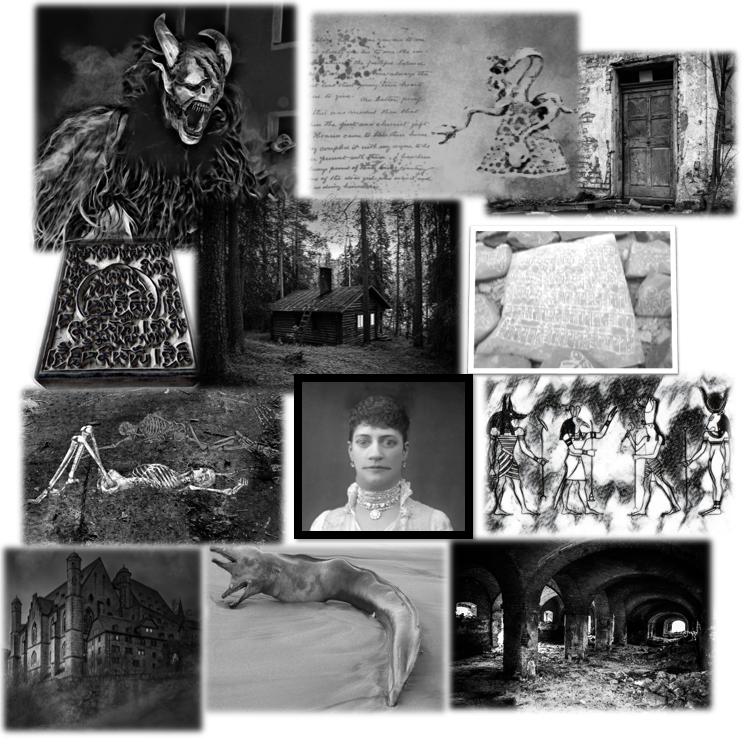
I quickly ruled out cartoon the pictures by hand, as I lacked both the skill and the time. Instead, I used a combination of free stock art, free image filters, and a few simple image editing tricks. I created about forty illustrations.
Hither's a sample:
Free pictures: the starting point
The basic recipe for illustration-on-the-cheap is unproblematic: take something gratuitous and brand it your ain.
The practiced news is that there are several million free images waiting for yous online. You'll find them on sites like pixabay.com, unsplash.com, and pexels.com. (My personal favorite is pixabay, because it does the all-time job with searches that have more one search word, like "flight woman" or "melting nutrient.") And if that'due south yet not enough, you can find more free-flick sources in this article.
If free stock art sounds as well expert to exist truthful, well — it actually isn't! There are no cached clauses or fine-print atmospheric condition designed to trap you lot into a subscription. Notwithstanding, wise writers recommend a fleck of due diligence (also known every bit covering your butt). Before you lot utilize a motion-picture show, search for copies on the web with a Google image search. If the image turns up in a paid stock art catalog or an artist's personal website, it could be a stolen photograph that isn't really in the public domain. A Google epitome search can also aid you identify pictures that are overexposed — ones that are already featured in dozens of other people's work.
Making information technology your ain
Now for the bad news. On its own, free stock art isn't enough to illustrate your book.
Here are some of the problems you lot'll face:
- You're sharing with everyone else. If you find something you like, odds are someone else has used it earlier (and other people will use it in the future). You desire your volume to stand up out as unique and creative, and that outcome is speedily undermined if your readers spot pictures they've already seen floating effectually in Facebook posts and Medium stories. This is a particular danger if you're using free art to create a book cover, in which example you demand to research very carefully.
- The selection is vast, but not limitless. You probably won't find exactly what yous want. Although free art sites are stocked with hundreds of thousands of interesting images, they can't cater to the idiosyncratic details of your story similar a professional illustrator would.
- Photos are not illustrations. Most of the images you'll find are photos or photo-realistic illustrations. This kind of content suits book covers and estimator games, but it can be jarring if you apply it for interior illustrations, where readers normally await artwork that looks "drawn."
- Continuity is difficult. If you need 2 dozen pictures, you can find two dozen pictures. Just getting them to have a common aesthetic is more than difficult. And if your pictures don't take some stylistic similarities, your book will feel similar a patchwork, and that screams "amateur!"
These challenges be with paid stock art also, they're but more obvious when you utilise a more limited stock art catalog. Fortunately, you can deal with all these problems by carefully and cleverly altering the images yous find.
Fob #one: Gratis art filters
If you're illustrating a work of fiction, you probably desire your pictures to look similar illustrations rather than photographs. In that location are exceptions to this dominion — think of the "found" photographs in Miss Peregrine'south Home for Peculiar Children, for instance. But illustrations are unremarkably best, because they help create a subtle remove between the reader and the writer. You fill up that gap with the fictional globe you've created.
Then what makes an image wait like an illustration? Tiny details similar pencil marks, brush strokes, and simplified colors and texture all contribute to the effect. For example, await at this gratuitous picture of a tree through a castle window.
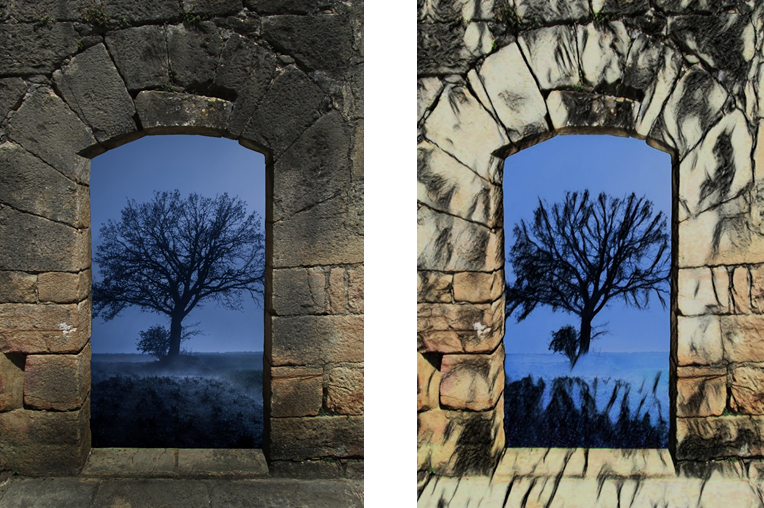
In the original pixabay picture (left), the texture of the stone blocks is clearly existent. If you lot're a photographer, you might even be distracted by the flash lighting reflected on the blocks. But the filtered version (right) removes these details, creating a more impressionistic, painting-like effect.
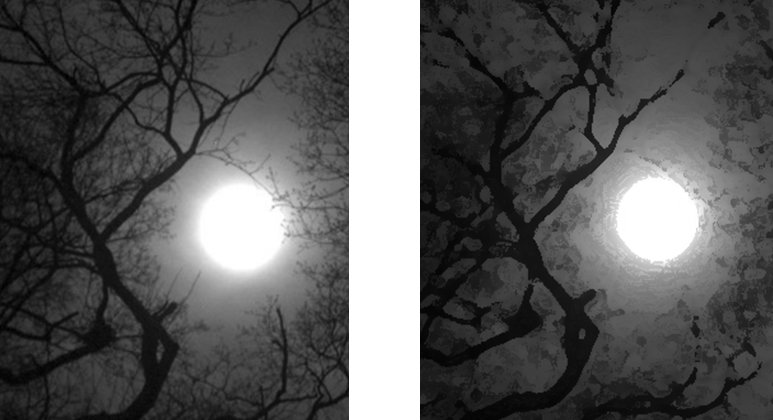
Here's the same effect with a moon:
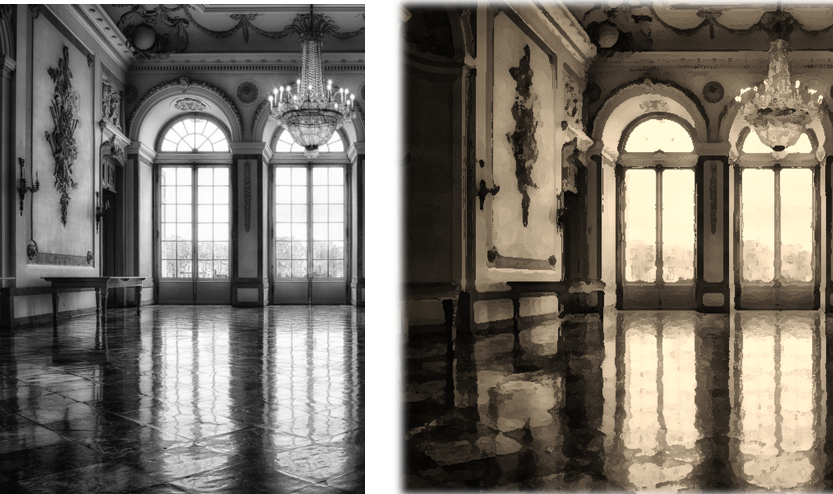
And I used information technology to turn an empty ballroom into a dream-similar vision:
At that place are several online image editors that can apply these sorts of filters. The all-time, by far, is LunaPic. Using LunaPic, you tin upload an prototype and cull from several dozen art filters, with no registration required. Utilise the Scribble, Sketch, Pen & Ink, Pencil, and Sketch2 filters to mimic hand-drawn styles. (All these filters strip the color out of your pictures. If that isn't what you desire, you can apply the color-preserving filters Color Scribble, Color Sketch, Color Pen, and Color Pencil instead.) Once you pick a filter, exist certain to adjust the intensity down from 100%. Ordinarily, you need just a touch to put your image somewhere betwixt a photo and a drawing.
Art filters don't just make your pictures expect less like photos, they can besides brand them look more than similar to each other. In my book, I used filters to give pictures a consequent atmosphere of gloom and mystery, which befits H. P. Lovecraft's supernatural horror. LunaPic has dozens of atmospheric filters, merely I relied on the Fume filter to make transformations like this:
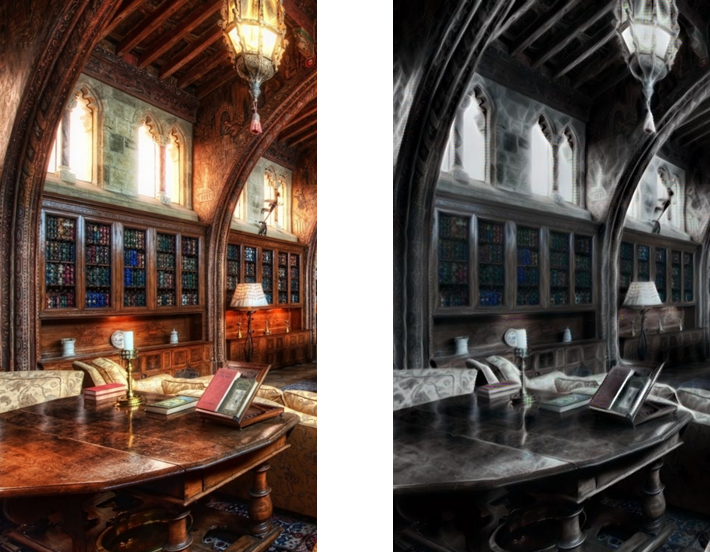
These changes helped to give my pictures thematic unity throughout the book.
(Quick legal annotation: It's perfectly to take costless stock art from one of the sites mentioned before, modify it however yous want, and use it in your work. However, most of the sites don't allow you lot to repost modified pictures, or sell them to other book writers.)
Fob #2: Changing images with the Clone tool
Sometimes you'll discover a perfect picture on a site like pixabay. Merely more oft you'll find a picture that's tantalizingly close to what you desire, but not quite correct.
Ofttimes you lot tin turn a not-quite-right picture into something more suitable with a little image editing magic. You lot don't need professional retouching skills for this job, or a pro software tool like Adobe Photoshop. Complimentary tools like GIMP and Pigment.Cyberspace work merely as well for essential tweaks. (I use Paint.Internet, simply if your computer doesn't run Windows yous'll need GIMP. If you're lucky plenty to have an expensive prototype editor like Corel PHOTO-PAINT or Adobe Photoshop — the gold standard — use that instead.)
One miraculous tool that nearly photograph-editing programs offer is cloning. Cloning allows you to have one part of your picture and "paint" information technology over another role. You lot choose how large a brush yous utilize, and how smoothly the new and old content should exist blended together.
Cloning comes in handy if you lot need to tidy upwards your picture show by removing details that don't belong. You can chop-chop paint over text, objects, and even people that shouldn't exist in the frame. Oft cloning can salvage a movie that would otherwise be unusable past removing some disqualifying detail.
You can see cloning at piece of work hither, removing a person from the groundwork:
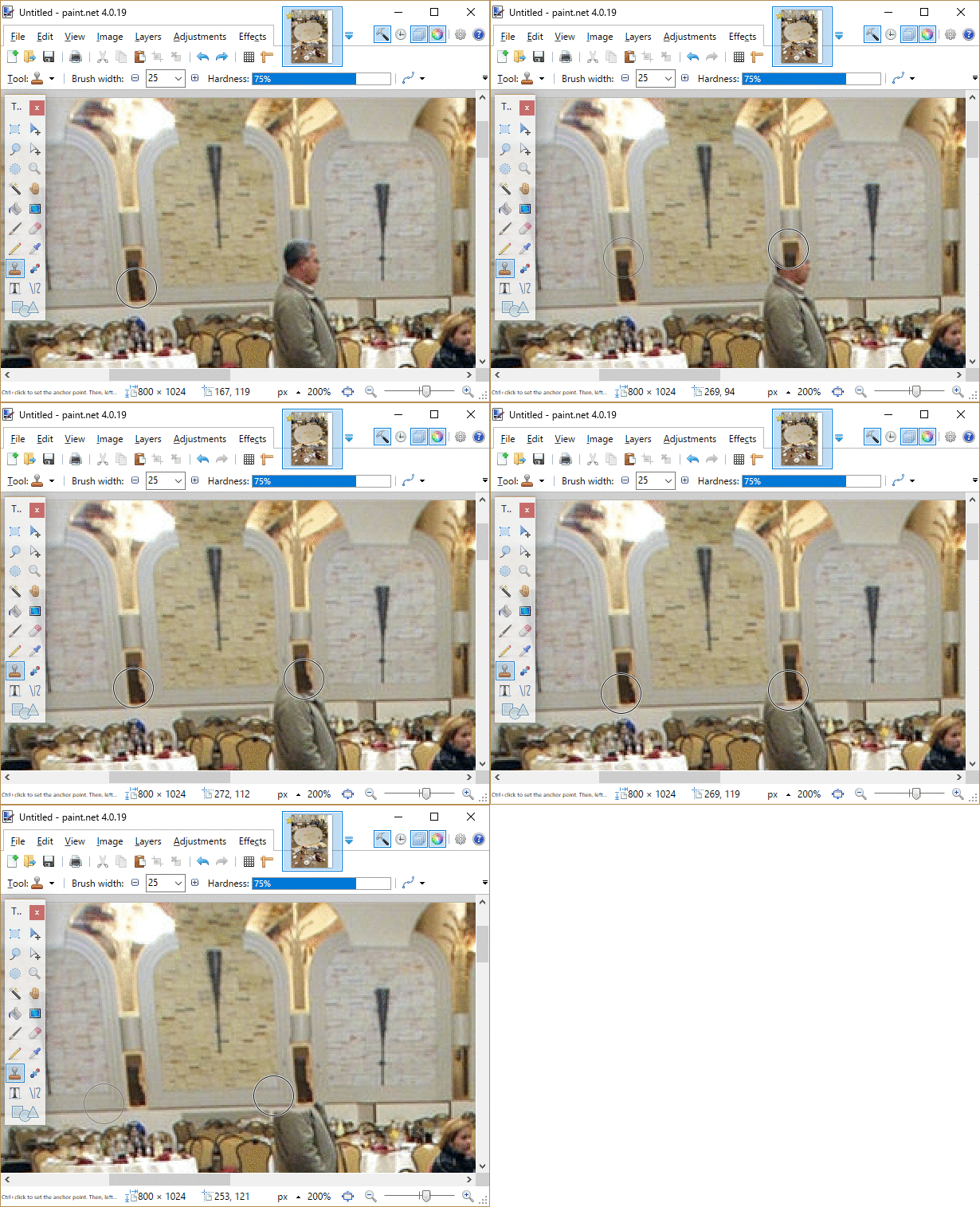
Every image editing programme is a bit dissimilar, but the cloning tool works in a strikingly similar style in all of them. Hither'due south the breakdown:
- Selection the Clone Stamp tool, choose the width of your brush (it's set at 25 pixels in the example above), and optionally set whatsoever other settings.
- Selection the expanse y'all want to copy. In Paint.NET or GIMP, you lot do this past belongings down the Ctrl key and clicking the correct identify on your picture. (In Photoshop, you lot hold downward Alt instead of Ctrl.)
- Click somewhere else to copy the selected area. Keep clicking or dragging to paint a larger region. Or, render to footstep 2 to pick a slightly unlike area to copy. (For example, in the person-erasing case yous'll need to grab background from unlike parts of the photo to properly finish the job.) Often, yous'll paint too much or notice out that source and destination regions aren't quite lined upwards. When that happens, quickly undo your mistake (hitting Ctrl+Z) and try again.
Cloning also lets you repeat and expand elements in your picture show. For example, you tin can turn a pocket-size pile of broken dishes into an epic mess. Cloning likewise lets you lot make more substantial changes, if you get a bit creative. For example, in Four Tales of Cthulhu several pictures utilize Tibetan letters as a stand up-in for the conflicting Yith language. To create a book in the bang-up Yith library, I took a box with a small section of Tibetan lettering, and extended information technology to cover the unabridged surface:

Here'southward another example where I took a free stock photo of a dapper old homo and, with a nuance of cloning and online an art filter, turned him into a reasonable facsimile of an quondam-fashioned wizard:
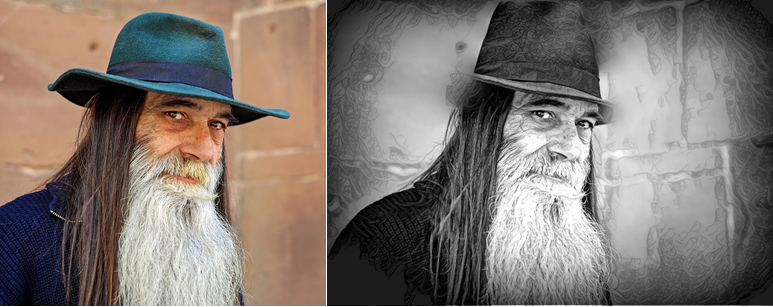
Don't worry too much about smudges and imperfections in your cloning work. If yous're planning to add together an fine art filter, information technology will disguise most small imperfections.
Flim-flam #3: Cropping and combining pictures
Cloning is a quick and dramatic tool for changing pictures. But y'all shouldn't overlook more than basic changes that can help make a movie uniquely your own. Endeavour rotating it, reversing it, or cropping out a small portion. Sites like pixabay provide generously sized versions of all their pictures, then yous'll rarely need to worry even if you crop downwardly to small-scale sections. A good dominion of pollex is to avoid falling in honey with the original moving picture. You lot'll get a stronger result by focusing on the small details that fit your book.
Sometimes you'll find free images that have a transparent background. On pixabay, these images are shown in the preview with a checkered background:
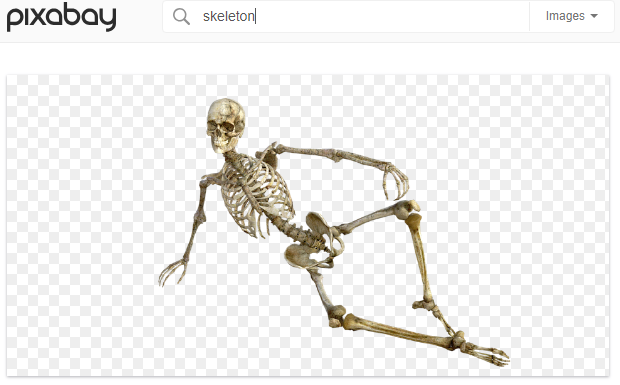
A background-free image is a particularly thoughtful souvenir from an paradigm creator. You lot can drib information technology onto another image to make a seamless new moving picture with hardly any effort.
I used it this technique to put a barred grate over a moonlit scene. I also took a couple of groundwork-gratis skeletons, resized them, and put them on summit of a small section I cropped from a picture of a ruined church hall to create this scene:
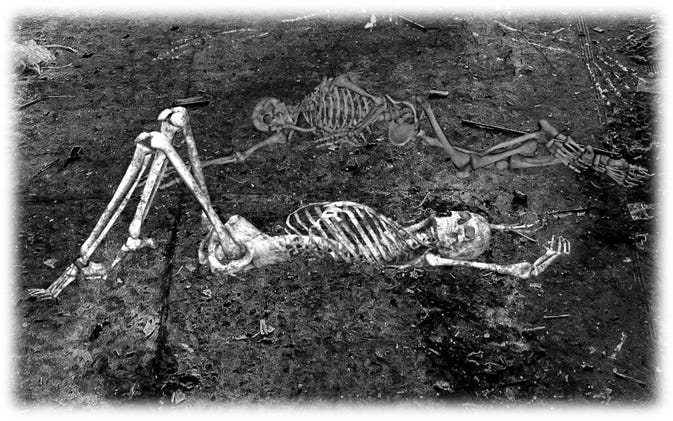
If you're new to the world of image editing, this process may accept an afternoon to figure out for the first time. You need to understand how to put each image in its ain layer, so that yous can resize each image separately. Catch upwardly with a couple of YouTube videos, and y'all'll exist set.
Trick #iv: Changing pictures with simple warps
One of the cloak-and-dagger tricks every image editor uses is a warping tool. Warps permit you to push around the shapes and edges in your picture. The magic is the style these edits are absorbed into your picture show. When you click and drag one betoken, the region around shifts and distorts to accommodate your change in a natural fashion.
Using a warp is even easier than using the cloning tool. It's simply a matter of picking a brush size, clicking somewhere on your picture, and gently pushing the pixels to the side. I used the warp tool on an former public domain photograph to create the surreal features known in H. P. Lovecraft lore as the "Innsmouth look."
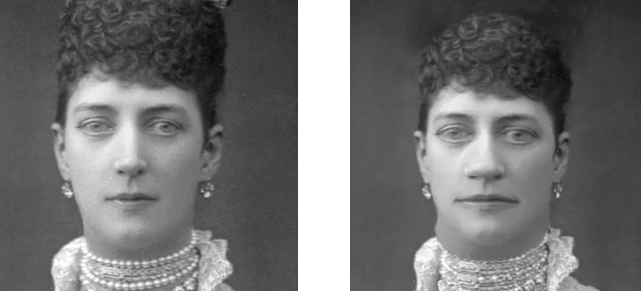
In GIMP, the warping feature is called iWarp. In Photoshop information technology's called Liquify. In Paint.Internet you lot need to add a plug-in like the free Liquify tool plant here.
Warps are often used on people to compress artillery, aggrandize eyes, and make strikingly thin models look even more outrageously sparse. It's a common and wildly popular tool. If yous're non sure how information technology works in your image editor, you'll have no trouble finding a video walkthrough on YouTube.
Hopefully these examples take inspired you to endeavor creating some pictures of your own. You might even find that the challenges of using free stock art inspires you to be more than creative in finding solutions. (It'south somewhat similar the manner that master poets are inspired to be more inventive when faced with the limitations of strict poetic forms.)
I've had the benefit of working with a publisher-funded illustrator before, and I can confidently say that none of these techniques volition replace a skilful creative person. However, they practice something else. They make information technology possible to add illustrations to a project that wouldn't ordinarily be able to afford them. They brand deadline projects — projects that might otherwise never see the low-cal of 24-hour interval — possible.
Happy illustrating!
humphreyshest1992.blogspot.com
Source: https://writingcooperative.com/how-to-illustrate-your-book-for-0-e1a5fe89375d
0 Response to "Classic Childrens Illustrations Public Domain Childrens Using Art Color Pencil"
Post a Comment